
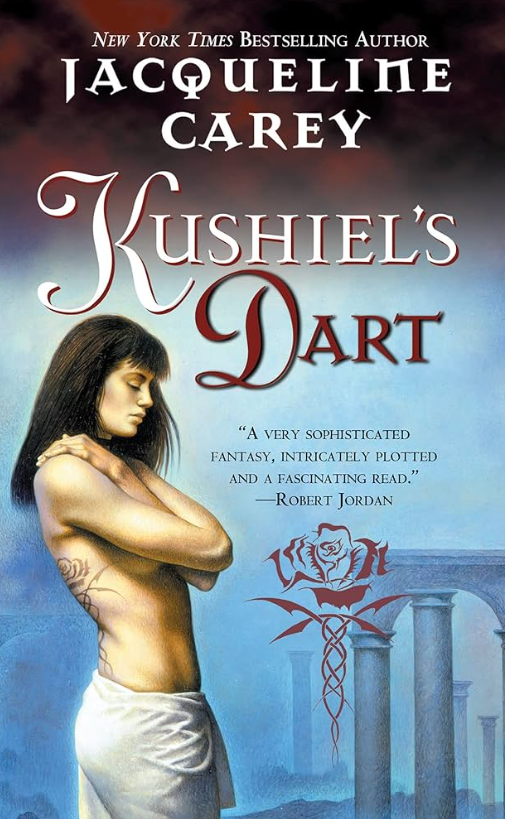
In the realm of high fantasy, narratives have long been dominated by patriarchal structures, where women serve as objects of desire, damsels in distress, or rewards for male heroes. Jacqueline Carey’s Kushiel’s Dart disrupts this model by presenting a world in which female sexuality is both sacred and strategic. At the novel’s center is Phèdre nó Delaunay, a courtesan and spy marked by a divine calling to experience pain as pleasure. Through Phèdre’s journey, Carey crafts a complex feminist text that challenges traditional gender roles, reclaims sexuality as power, and presents a spiritually empowered femininity rarely seen in speculative fiction. A feminist reading of Kushiel’s Dart reveals how the novel critiques patriarchal norms, affirms sexual autonomy, and reimagines divine femininity as a source of personal and political agency.
Phèdre’s identity as an anguissette who finds pleasure in pain is central to her power and the novel’s feminist subtext. In most literary traditions, female masochism has been portrayed as pathological or degrading. Carey reclaims this trait, granting it divine significance. Phèdre is “touched by Kushiel,” one of the angels descended from the union of Yeshua’s blood and Magdelene’s tears, imbuing her sexuality with sacred meaning (Carey 13). This reframing directly challenges the patriarchal tendency to separate spirituality and sensuality. Rather than being a source of shame, Phèdre’s eroticism is holy: “For the D’Angelines, sex was a form of worship, and we paid homage with our bodies” (Carey 82). Her submission is not forced or exploitative; it is freely chosen and profoundly empowering, upending the notion that pain, or sexual submission equals weakness.
The world of Terre d’Ange also complicates the social understanding of gender and power. Unlike traditional fantasy settings, where noblewomen are limited to courtly roles or romantic subplots, Carey populates her world with women of influence: queens, ambassadors, spymasters, and warriors. However, Carey does not idealize this power; it is fraught with manipulation, betrayal, and personal cost. Phèdre must navigate a society that, despite its liberal sexual values, still judges her for being “the whore of Kushiel” (Carey 344). This dynamic allows Carey to critique internalized misogyny even within seemingly liberated spaces. The Night Court, while progressive in many ways, still stratifies pleasure houses by gendered expectations, and not all houses respect anguissettes equally. Feminist theorist Bell Hooks argues that “patriarchy has no gender” (hooks 18), and Carey’s depiction of Terre d’Ange reflects this tension between freedom and control.
Phèdre’s occupation as a courtesan, often dismissed or vilified in traditional narratives, is legitimized and elevated in Kushiel’s Dart. The story does not objectify her but wields her sexuality like a weapon, using it to gain access to political secrets, influence high-ranking nobles, and shape the fate of nations. Her body becomes a site of knowledge and resistance. In a pivotal moment, she reflects, “I had chosen to make my body a weapon, and I wielded it in service to my nation” (Carey 451). This assertion positions sex work not as a last resort but as a vocation of agency and patriotism, reframing the erotic laborer as a legitimate and influential figure. From a feminist standpoint, Phèdre’s ability to consent to her bodily expression is crucial, aligning with Audre Lorde’s notion of the erotic as power: “When I dare to be powerful, to use my strength in the service of my vision, then it becomes less and less important whether I am afraid” (Lorde 55).
Carey also emphasizes consent in deeply feminist ways. Though Phèdre engages in sexual acts that involve dominance and submission, the scenes are grounded in mutual agreement and deep trust. This reinforces a model of sexual autonomy that prioritizes individual choice and rejects coercion. Her relationship with Joscelin Verreuil, a Cassiline Brother sworn to celibacy, evolves from mutual misunderstanding to emotional reciprocity. Joscelin struggles to reconcile Phèdre’s sacred sexuality with his rigid beliefs but ultimately chooses to respect her path. “He did not ask me to change, only to explain,” Phèdre notes (Carey 534). Their relationship subverts the standard fantasy trope where male love interests redeem or rescue “fallen” women; instead, Joscelin grows by unlearning his patriarchal conditioning.
Religion and mythology in Kushiel’s Dart are also profoundly feminized. The foundational myth of Terre d’Ange centers on Elua, born of “the tears of Magdelene and the blood of Yeshua,” blending Christian iconography with goddess worship (Carey 12). This theogony places feminine grief and strength at the heart of creation, suggesting a divine balance often absent in Abrahamic traditions. Many of Elua’s companions, including Naamah, the progenitor of the Night Court, are women who shape the moral and sexual landscape of the world. Naamah’s choice to sell her body to feed Elua is seen not as degradation but as a holy act of love. This mythological framing serves as a feminist reclamation of the divine feminine, aligning with Carol P. Christ’s call to return “female images of divinity to legitimate female power and authority” (Christ 318).
Importantly, Phèdre’s journey is not one of becoming like a man to gain power, as seen in many feminist revisionist texts, but of embracing and elevating her femininity. She does not trade beauty for strength or submission for dominance. Instead, she fuses them into a third, liminal identity that destabilizes binary gender expectations. This hybridity reflects Judith Butler’s theory that gender is not a stable identity but a performance: “There is no gender identity behind the expressions of gender; that identity is performatively constituted by the very ‘expressions’ that are said to be its results” (Butler 25). Phèdre performs femininity and sexuality on her terms, rejecting imposed definitions.
Through Phèdre and the world of Terre d’Ange, Jacqueline Carey offers a bold feminist vision that celebrates sexual agency, spiritual equality, and emotional strength. Kushiel’s Dart resists the traditional fantasy script of male conquest and passive femininity, instead placing a complex, erotic, and intellectual woman at its center. By doing so, Carey not only tells a compelling story but also challenges the frameworks that have historically constrained women in fiction and reality.
Works Cited
Butler, Judith. Gender Trouble: Feminism and the Subversion of Identity. Routledge, 1990.
Carey, Jacqueline. Kushiel’s Dart. Tor Books, 2001.
Christ, Carol P. “Why Women Need the Goddess: Phenomenological, Psychological, and Political Reflections.” Womanspirit Rising: A Feminist Reader in Religion, edited by Carol P. Christ and Judith Plaskow, HarperOne, 1992, pp. 273–287.
Hooks, bell. Feminism Is for Everybody: Passionate Politics: south End Press, 2000.
Lorde, Audre. Sister Outsider: Essays and Speeches. Crossing Press, 1984.
 reelinsightswithmontana.com